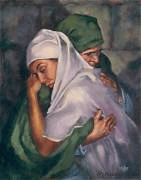
Week 37:
The bit where I introduce:
One of the gems I heard when I got married both times was this statement:
“You are not just marrying a man, but his entire family.”
There’s probably a little truth in that, to whatever extent it applies to your situation!
It can bring up both positive and negative connotations. Extended family can be a source of incredible love, belonging and support… and sometimes, let’s be honest, a source of complexity, tension and very different personalities! But family relationships matter. And sometimes the people we become connected to through marriage, circumstance or choice can become some of the most significant relationships in our lives.
One of the beautiful examples of female solidarity and a mother-in-law/daughter-in-law relationship in the Bible is found in Ruth and Naomi. I think theirs is one of the most powerful stories of love and loyalty that transcends culture, age and blood.
There are some really moving themes intertwined throughout their story, themes that I think are worth highlighting in our relationships with family and with one another today:
Selfless love.
Cross-cultural connection.
Intergenerational respect.
Loyalty.
And the power of simply showing up.
The bit where I refer to the Bible and ask a few rhetorical questions:
Ruth 1:16 — read the entire chapter
“Where you go I will go, and where you stay, I will stay. Your people will be my people, and your God will be my God.”
Now, I’m not sure there are many daughters-in-law these days who would make quite such a declaration of allegiance to their mother-in-law!
Although perhaps some of you know a relationship like this?
Ruth’s decision is extraordinary because she chooses to leave behind her homeland, culture, family and security to remain with Naomi. She had no guarantee of safety, provision or a future. From a purely practical perspective, returning to Moab probably made more sense.
Naomi herself seems to recognise this. Having lost her husband and both her sons, she encourages Ruth and Orpah to return to their own families, where they might have a better chance of finding security and rebuilding their lives.
In other words, Naomi isn’t clinging to them for her own survival. She is thinking about their future.
There is something beautiful about that kind of love too, love that doesn’t possess, but releases. But Ruth chooses differently.
She chooses Naomi. And perhaps even more profoundly, she chooses Naomi’s people and Naomi’s God. This isn’t simply a sentimental mother-in-law/daughter-in-law story. Ruth, a Moabite woman, is crossing a significant cultural and historical divide to bind herself to Naomi and Israel.
The journey ahead would not necessarily be comfortable or safe. Two widowed women travelling together, dependent on one another, entering Bethlehem with very little security, was hardly the picture of independence or prosperity.
Yet somewhere along that difficult journey, their relationship becomes a partnership of mutual care. Ruth works. She provides. Naomi offers wisdom and guidance. Neither has everything the other needs, but together they find a way forward.
And perhaps that is one of the things solidarities really means. Not that we can fix everything for each other, but that we don’t have to face everything alone.
Naomi arrives in Bethlehem describing herself as “empty.” Her grief has changed how she sees herself and her circumstances. But Ruth’s presence becomes part of the story of what happens next. Ruth doesn’t erase Naomi’s grief. She doesn’t magically fix her circumstances. But she stays. And sometimes staying is one of the most profound expressions of love we can offer. I think there is also something beautiful about the intergenerational nature of their relationship.
In a culture where family roles and expectations were very different from ours, these two women develop something deeper than obligation. There are examples of friendship, loyalty, protection and genuine affection.
Later, Naomi’s relationship with Ruth’s son Obed becomes another beautiful picture of restoration. The woman who once described herself as empty is holding a child who will become part of the family line that ultimately leads to David, and, within the larger biblical story, to Jesus.
The book of Ruth reminds us that God can be doing something much bigger than we can see while we are simply trying to survive the next chapter. And perhaps one of the most beautiful lines comes when the women of Bethlehem say to Naomi:
“Your daughter-in-law who loves you… is better to you than seven sons.”
(Ruth 4:15)
That’s quite the mother-in-law compliment! But it captures something profound. Ruth’s love had become evidence that Naomi was not alone.
We live in a world that highly values independence. We celebrate being self-sufficient, having our own lives and not needing anyone. And independence has its place. But Ruth and Naomi remind us that God did not design us to carry everything alone.
Scripture repeatedly calls us to bear one another’s burdens, to care for one another, to welcome one another and to love beyond the boundaries that naturally divide us.
Sometimes family isn’t easy. Sometimes there are cultural differences, generational differences, personality differences, blended families, complicated histories and relationships that don’t look anything like the picture we imagined.
But perhaps solidarity asks us a different question.
Can I choose love over convenience? Can I show up when it costs me something? Can I respect someone whose life experience is completely different from mine? Can I make room for another person’s culture, generation or story? Can I love without needing to control? Can I stay present in someone’s difficult season without feeling like I have to fix it?
And perhaps most importantly:
Can I recognise that God may use the people around me, sometimes people I never expected, to bring companionship, wisdom, provision and hope into places that feel empty?
Redemption doesn’t always begin with circumstances changing. Sometimes it begins with someone staying. Someone walking beside us. Someone carrying a little of the weight. Someone crossing a boundary to say, “You don’t have to do this alone.”
The beautiful lesson for me is that God can redeem our emptiness through connection, crossing cultures, generations, circumstances and even the relationships we never expected to become significant.
Ruth and Naomi didn’t know what their story would become. They simply took the next step together. Not having all the answers. Just refusing to walk away from one another.
The bit where you get to think about stuff: Questions for the week.
How can I support someone who is walking through a season of bitterness or loss without rushing them past their pain?
Can you think of a time when choosing the loyal or right path required you to make a significant personal sacrifice?
How can we practically look for the “Naomi’s” in our lives this week and help carry their burdens?
 Unfinished Faith: Relearning God.
Leave a comment